Some links on this page may generate a commission for EBusiness Reviews when you purchase through them, at no additional cost to you. Our ratings remain independent.
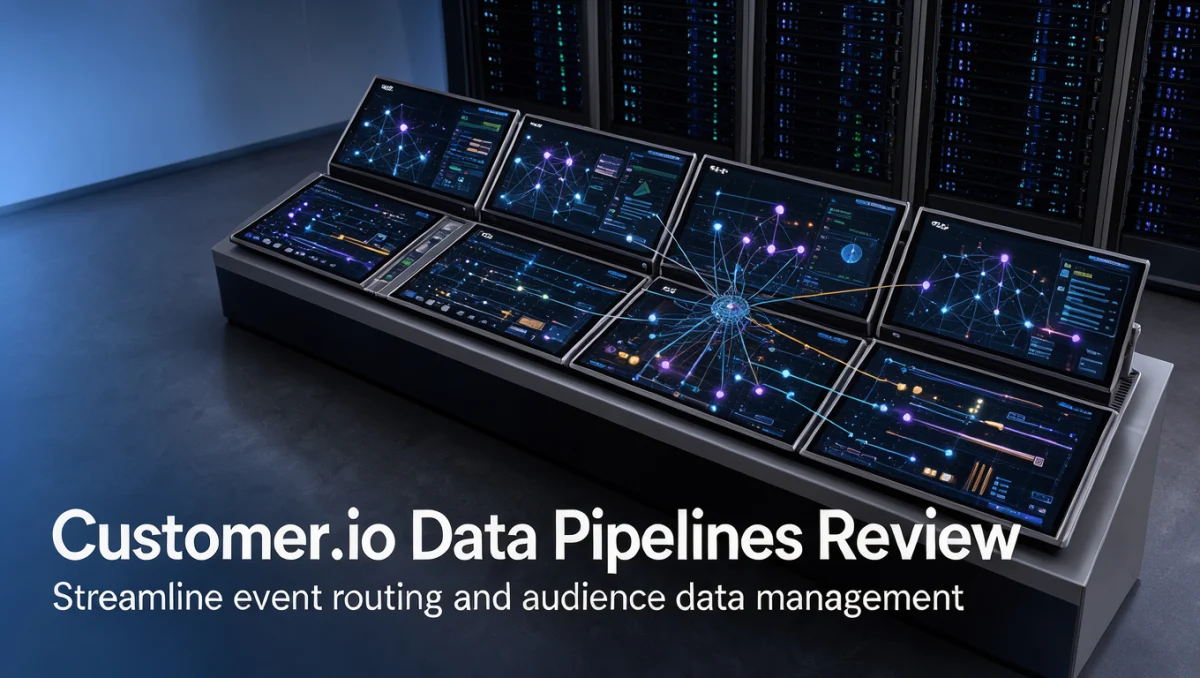
Customer.io Data Pipelines works as a central customer data layer that gathers event information from websites and apps, then forwards it to marketing and analytics destinations. Companies that want control over their customer records without building and maintaining their own internal data routing servers should judge this product on three things: how flexible its pipelines are, how well it transforms data, and how strictly it governs schemas. Here at EBusiness Reviews, we look at how pipeline tools help businesses keep data flowing cleanly into messaging platforms and analysis systems.
Behavioral data is often scattered across mobile apps, desktop products, and transaction systems. Dedicated pipeline infrastructure lets operations teams capture each event a single time and send it at once to messaging engines, data warehouses, and other operational endpoints.
Quick verdict: Customer.io Data Pipelines scores 7.8/10 overall. It suits growth-oriented companies, product-led businesses, and data teams that want event collection tied directly to messaging. It is a weaker match for solo operators or lean teams with simple transactional messaging needs and no complex multi-destination data flows.
| Evaluation Dimension | Summary |
|---|---|
| EBusiness Reviews score | 7.8/10 |
| Best for | Organizations managing customer behavioral data across several analytics destinations and messaging tools |
| Not ideal for | Operators who only send occasional batch messages without multi-channel tracking needs |
| Key strengths | Unified event routing, flexible schema management, and direct pairing with messaging automation |
| What to check before buying | Destination limits, volume structures, and pipeline configuration requirements on the official vendor website |
1. How EBusiness Reviews Evaluated Customer.io Data Pipelines
This review covers what Customer.io Data Pipelines is designed to do, who it serves, and how it stacks up against comparable tools. We assess it across seven EBusiness Reviews criteria: features, ease of use, pricing and value, integrations, audience fit, support, and competitive position. Plans, prices, and limits change frequently, so we flag what you should confirm on the official website before purchasing. This article was researched and drafted with AI assistance, then reviewed and edited by the EBusiness Reviews Editorial Team.
2. What Customer.io Data Pipelines Is and Who It Serves
Customer.io Data Pipelines is a customer data infrastructure solution built to capture, clean, and transmit first-party user actions to business tools. Instead of writing separate tracking code for email engines, product analytics dashboards, and cloud storage destinations, teams instrument their tracking libraries once. The platform then acts as an event distribution broker, sending identity traits and behavioral triggers wherever they are needed.
The product targets a common bottleneck: engineering departments repeatedly adding or changing vendor tracking snippets. When tracking requirements shift, teams can adjust routing through a pipeline interface rather than deploying code changes across application codebases. This keeps the schema consistent across systems while reducing instrumentation upkeep.
Primary users include engineering leads, marketing operations professionals, and analytics architects at software companies, commerce platforms, and subscription businesses. Organizations that pair customer data infrastructure with dedicated Customer Service help desks and communication channels often gain clearer visibility across the customer lifecycle.
3. Core Features of Customer Data Pipelines

Customer data pipelines center on structural data integrity, consistent routing, and identity resolution across varied systems. Understanding these functional pillars helps prospective buyers judge whether dedicated pipeline software fits their data architecture.
3.1. Event Collection and Ingestion
Event ingestion records granular user interactions such as signups, page views, feature usage, and purchases. Client-side libraries and server-side endpoints provide continuous collection across web applications, mobile platforms, and backend servers. Centralized collection keeps payloads consistent across different operating environments.
3.2. Data Transformation and Payload Filtering
Incoming data streams rarely match the requirements of every external destination. Transformation features let data specialists rename fields, strip unnecessary properties, standardize timestamps, and filter payloads before forwarding. This middle-layer governance stops non-compliant attributes or unstructured fields from polluting downstream databases.
3.3. Destination Syndication and Routing
Destination routing sends filtered event streams to analytics platforms, advertising channels, data warehouses, and customer engagement tools. By switching connections on or off in one central interface, operators distribute first-party data without redeploying core application code.
4. Ease of Use and Learning Curve
Implementing customer io data pipelines requires coordination between engineering groups, product managers, and downstream marketing practitioners. Day-to-day management through a graphical interface is straightforward, but setting up tracking plans demands careful planning.
4.1. Implementation Demands and Schema Design
The initial setup requires defining consistent event naming conventions and user property schemas. Teams that document a tracking dictionary before launch onboard more smoothly than those trying to normalize ad hoc event streams after the fact.
4.2. Day-to-Day Pipeline Administration
Once pipelines are running, non-technical team members can review delivery metrics, check event frequencies, and confirm that new attributes arrive correctly. Complex transformation scripts and identity reconciliation logic, however, remain tasks best left to experienced data professionals.
5. Pros and Cons
Evaluating customer data infrastructure means weighing operational flexibility against technical commitment and ongoing governance obligations.
5.1. Advantages of Dedicated Pipeline Infrastructure
- Reduces redundant tracking instrumentation across internal product codebases
- Provides centralized visibility into event delivery status across destinations
- Aligns raw customer behavior directly with marketing automation
- Maintains consistent payload formats across independent operational tools
5.2. Practical Challenges and Operational Tradeoffs
- Requires disciplined schema governance to prevent schema fragmentation
- Needs initial developer involvement to implement SDKs and server events
- Adds architectural complexity compared with simple point-to-point connections
- Calls for careful verification of event delivery guarantees in official documentation
6. Customer.io Data Pipelines vs. Similar Tools
Customer data infrastructure is a competitive category with established platforms such as Twilio Segment, RudderStack, and mParticle. Understanding where Customer.io Data Pipelines sits in this landscape clarifies which architectural approach best fits your goals.
| Platform | Primary Focus | Consideration Factor |
|---|---|---|
| Customer.io Data Pipelines | Unified pipeline routing closely aligned with customer communication activation | Best for teams wanting integrated event collection and messaging execution |
| Twilio Segment | Enterprise customer data infrastructure with extensive protocol libraries | Suited to organizations with mature data architectures and substantial budgets |
| RudderStack | Warehouse-first customer data pipelines geared toward data engineering teams | Ideal for technical groups centered on centralized cloud data lakes |
| mParticle | Mobile-centric customer data platform emphasizing multi-channel app ecosystems | Designed for enterprise mobile brands with complex app suites |
Buyers should decide whether their main goal is warehouse synchronization, cross-tool syndication, or feeding real-time engagement workflows. Software that connects natively to downstream execution tools often simplifies daily marketing operations.
7. Who Should Use Customer.io Data Pipelines
Software platforms fit distinct operational profiles. Confirming that your team matches the target user profile helps you avoid misallocating technical resources.
7.1. Growth-Stage Companies and Software Providers
Businesses running subscription applications benefit significantly from centralized event routing. When trial activations, onboarding milestones, and feature clicks flow cleanly into both messaging sequences and analytics storage, cross-functional teams stay aligned.
7.2. Marketing and Data Operations Teams
Operations professionals managing dozens of SaaS tools gain from controlling event routing through a single hub. Turning data streams on or off without opening engineering tickets speeds up experimentation and response times.
7.3. Organizations That Should Consider Alternatives
Early-stage projects with single-channel communications, static content websites, or no dedicated analytics infrastructure may find dedicated pipelines more than they need. Simple direct connections often suffice until event volumes and destination variety grow.
8. How to Choose the Right Plan
Subscription models for customer data software generally scale with data volume, destination variety, and advanced routing capabilities. Prospective buyers should review official vendor pricing pages using a structured checklist.
| What to check | Why it matters |
|---|---|
| Event volume thresholds | Billing often scales with monthly tracked users or total events transmitted |
| Destination availability | Certain downstream tools or specialized warehouse connectors may be categorized differently |
| Transformation capabilities | Advanced payload restructuring functions may depend on account structure or tier |
| Historical data retention | Playback, event debugging, and log storage windows differ across plans |
| Technical assistance levels | Implementation guidance and response commitments vary by commercial agreement |
9. Frequently Asked Questions
What should teams prepare before implementing a customer data pipeline?
Teams should build a standardized tracking plan that details core event names, associated property keys, and required destinations. Agreeing on naming guidelines before data starts flowing prevents conflicting schemas across web and mobile platforms.
How do data pipelines differ from customer messaging engines?
Data pipelines collect, format, and route event payloads from digital touchpoints to various external endpoints. Messaging engines consume those events to trigger personalized communications such as emails, push notifications, and in-app alerts based on customer actions.
Why do businesses use data pipelines instead of point-to-point connections?
Point-to-point integrations require developers to embed a separate tracking script for every marketing and analytics vendor. Data pipelines let teams implement one tracking layer and configure downstream routing through an administrative interface, saving engineering time.
What factors influence total operational costs for pipeline tools?
Total spend typically reflects event ingestion volume, the number of active tracked profiles, and destination configurations. Organizations should also account for developer time during implementation and storage charges in connected analytics databases.
10. Final Verdict
| Criterion | Score /10 | Reason |
|---|---|---|
| Features | 8.4 | Strong event routing, payload transformation, and schema governance capabilities |
| Ease of Use | 7.4 | Administrative interfaces are straightforward, though initial tracking setup requires technical resources |
| Pricing and Value | 7.1 | Buyers must verify volume tiers and overage terms on official pricing pages |
| Integrations | 8.1 | Connects cleanly to core analytics destinations, cloud databases, and marketing engines |
| Audience Fit | 8.6 | Well aligned for product-led businesses and teams combining data collection with messaging |
| Support | 7.2 | Support options and technical guidance should be confirmed against specific service agreements |
| Competitive Position | 7.8 | Offers a compelling unified model compared with standalone infrastructure platforms |
Overall score: 7.8/10
Customer.io Data Pipelines offers a coherent way for businesses to reconcile disparate customer event streams without maintaining fragile custom infrastructure. For organizations orchestrating event-driven customer communications alongside backend analytics, consolidating event collection in this platform brings dependable operational clarity.
Readers with questions about data infrastructure evaluation or marketing stack decisions can contact our editorial team at https://ebusinessreviews.net/contact/, or follow EBusiness Reviews on LinkedIn at https://www.linkedin.com/company/ebusinessreviews/ for ongoing industry analysis.